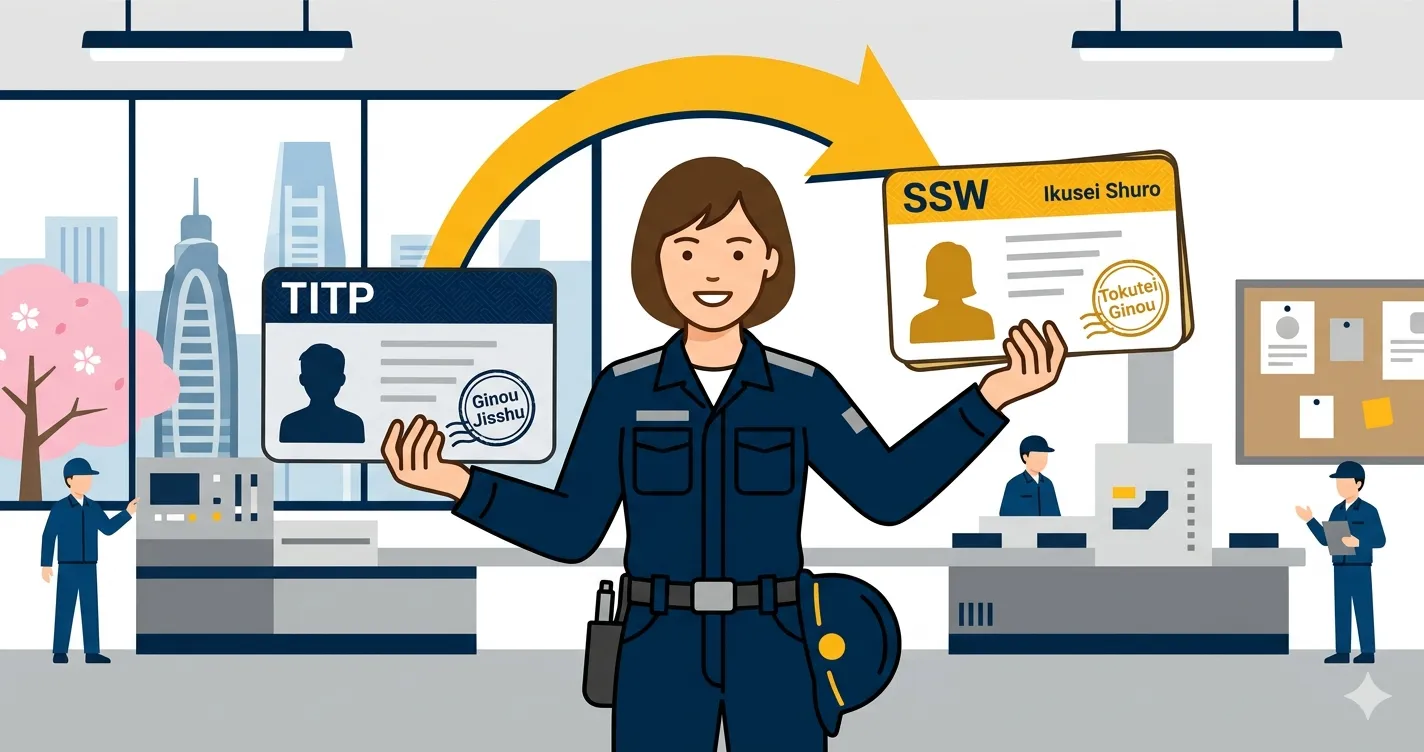
Ikusei Shuro (育成就労) 2027: Complete Guide for TITP Workers Transitioning to the New System
🇯🇵 日本語要約
【育成就労制度 2027年完全ガイド】2027年4月、技能実習制度が廃止され「育成就労制度」に移行。主な変更点:①1年後から同職種内での転職可能、②入国前にN5、特定技能移行にN3が必要、③送出し機関の管理強化。現在の技能実習生は2027年4月以降もビザ有効期限まで現制度継続。賢い選択:今すぐN3の勉強を始め、技能実習修了後に特定技能1号へ直接移行することを目指す。
What is Ikusei Shuro?
Ikusei Shuro (育成就労制度) is Japan's new foreign worker training system that will replace the Technical Intern Training Program (TITP / 技能実習) starting April 2027.
If you are currently on a TITP visa, or planning to come to Japan as a technical intern, this guide explains everything you need to know about what changes and what stays the same.
Why is Japan Replacing TITP?
The Technical Intern Training Program (技能実習制度) was heavily criticized for:
- Forcing workers to stay with abusive employers
- Restricting job changes even in dangerous conditions
- Being used as cheap labor rather than genuine training
- High rates of runaway workers (失踪) due to poor conditions
The new Ikusei Shuro system is designed to fix these problems by giving workers more rights and a clearer path to long-term residence.
Key Differences: TITP vs Ikusei Shuro
| Item | TITP (Old) | Ikusei Shuro (New) |
|---|---|---|
| Main purpose | "Training" (名目) | Actual skill development |
| Job change | ❌ Almost impossible | ✅ Allowed after 1 year |
| Japanese required | None officially | N5 before entry, N3 within 1-2 years |
| Duration | 3–5 years | Up to 3 years |
| Path to SSW1 | Possible but unclear | ✅ Direct and automatic |
| Worker rights | Very limited | Stronger protections |
| Complaint system | Weak | New dedicated body |
| Sending countries | Many | Partner countries only |
| Employer obligation | Low | Higher accountability |
Timeline: When Does This Happen?
| Date | What Happens |
|---|---|
| June 2024 | Ikusei Shuro Act passed by parliament |
| 2024–2026 | Government sets up new infrastructure |
| April 2027 | Ikusei Shuro system officially launches |
| April 2027 onwards | New workers enter under Ikusei Shuro only |
| After April 2027 | Existing TITP workers transition gradually |
⚠️ Important: If you are currently on TITP, you do NOT automatically switch on April 2027. You continue under your current status until your visa expires, then transition.
Japanese Language Requirements (NEW)
This is the biggest practical change. Under TITP, no Japanese was required. Under Ikusei Shuro:
| Stage | Requirement | When |
|---|---|---|
| Before entry | JLPT N5 OR equivalent | Must pass before coming to Japan |
| Within 1 year | Working toward N4 | While working in Japan |
| To advance to SSW1 | JLPT N3 | Required to transition to SSW |
💡 Yamada Hack: Start studying Japanese NOW, even if you are still on TITP. Workers who reach N3 before April 2027 will have a massive advantage — they can transition to SSW1 immediately and request job changes legally.
Can You Change Jobs Under Ikusei Shuro?
Yes — this is the biggest improvement over TITP.
Under TITP: Job change was almost impossible. Workers were tied to their employer. Many ran away (失踪) instead.
Under Ikusei Shuro:
- After 1 year with the same employer, you can request a job change
- You must have a valid reason (poor working conditions, low pay, company closure)
- The new system has an official mediation body to help
- You can change within the same job category (same skill area)
⚠️ Limit: You cannot freely change to any job. The change must be within your designated skill sector (e.g., construction workers cannot switch to food service).
Path from Ikusei Shuro to SSW1
This is the biggest benefit of the new system — a clear, automatic path to long-term residence:
Step 1: Complete Ikusei Shuro (up to 3 years)
↓
Step 2: Pass the SSW1 skills test for your sector
Step 3: Pass JLPT N3 (or equivalent)
↓
Step 4: Apply for Specified Skilled Worker 1 (特定技能1号) visa
↓
Step 5 (optional): After SSW1, apply for SSW2 — which has NO time limit and can lead to PR
| Visa | Max Stay | PR Possible? |
|---|---|---|
| Ikusei Shuro | 3 years | ❌ No |
| SSW1 | 5 years total | ❌ No (directly) |
| SSW2 | Unlimited | ✅ Yes |
What Happens to Current TITP Workers?
If you are currently on TITP, here is what happens:
Option 1: Stay on TITP until it expires
- Your current TITP visa remains valid until its expiry date
- You continue working under the same rules
- When it expires, you can apply for SSW1 if you meet the requirements
Option 2: Early transition to Ikusei Shuro (if available)
- The government may allow early transition for some workers
- Details are still being finalized
- Check with your employer or sending organization
Option 3: Transition to SSW1 directly
- If you already meet the SSW1 requirements (skills test + N4/JFT-Basic), apply for SSW1 now
- Do not wait for April 2027
💡 Yamada Hack: The smartest move for current TITP workers is to take the SSW1 skills test for your sector NOW. If you pass, you can switch to SSW1 immediately — better pay, more rights, and no need to worry about the 2027 transition.
Eligible Countries (Partner Countries)
Ikusei Shuro will only accept workers from designated partner countries that have bilateral agreements with Japan. The current list includes:
Cambodia, China, Indonesia, Myanmar, Nepal, Philippines, Thailand, Vietnam, and others to be announced.
⚠️ Note: The full partner country list will be confirmed closer to April 2027. Check the Ministry of Justice website for updates.
Sectors Covered by Ikusei Shuro
The new system covers the same sectors as TITP, including:
Agriculture (農業), Fishery (漁業), Construction (建設), Food Manufacturing (食品製造), Textile (繊維), Machinery (機械), Electronics (電気), Shipbuilding (造船), Automobile Repair (自動車整備), Aviation (航空), Accommodation (宿泊), Nursing Care (介護), Building Cleaning (ビルクリーニング), and others.
New Worker Rights Under Ikusei Shuro
| Right | Details |
|---|---|
| Job change after 1 year | Can request transfer within same sector |
| Minimum wage guarantee | Same as Japanese workers in same role |
| Overtime rules | Must follow Japanese Labor Standards Act |
| Complaint hotline | New dedicated government body |
| Sending fee limits | Caps on fees charged by sending organizations |
| Housing standards | Employer must provide adequate housing |
Useful Japanese Phrases
| Situation | Japanese | Romaji |
|---|---|---|
| I want to change jobs | 仕事を変えたいです | Shigoto wo kaetai desu |
| My working conditions are bad | 労働条件が悪いです | Rodo joken ga warui desu |
| I want to take the Japanese test | 日本語のテストを受けたいです | Nihongo no tesuto wo uketai desu |
| I want to apply for SSW | 特定技能に申請したいです | Tokutei gino ni shinsei shitai desu |
| Please help me | 助けてください | Tasukete kudasai |
FAQ
Q: Will my TITP visa be cancelled in April 2027?
A: No. Your existing TITP visa remains valid until its expiry date. April 2027 is when the NEW system launches — existing visas are not affected immediately.
Q: Can I bring my family on Ikusei Shuro?
A: No. Family members cannot accompany workers on Ikusei Shuro status. This changes when you upgrade to SSW2.
Q: What if my employer treats me badly under Ikusei Shuro?
A: The new system has an official dispute resolution body. You can also request a job change after 1 year. If you face abuse, contact the Labor Standards Bureau (労働基準監督署) or call the Foreign Workers Consultation Center.
Q: Is N3 required to get Ikusei Shuro visa?
A: No — N5 is required before entry, and N3 is required to ADVANCE to SSW1. You do not need N3 just to enter the Ikusei Shuro system.
Q: What is the difference between Ikusei Shuro and SSW1?
A: Ikusei Shuro is a 3-year training period for workers who need to develop skills. SSW1 is for workers who already have skills. Ikusei Shuro is the pathway INTO SSW1 for new workers.
Q: Can I apply for PR after Ikusei Shuro?
A: Not directly. You need to go Ikusei Shuro → SSW1 → SSW2 → PR. SSW2 has no time limit and can lead to permanent residency.
Action Checklist
- [ ] Check your current TITP visa expiry date
- [ ] Start studying Japanese (target N3 for SSW1 transition)
- [ ] Research SSW1 skills test for your sector at jitco.or.jp
- [ ] Talk to your employer about transition plans
- [ ] Contact your sending organization for guidance
- [ ] If conditions are bad, contact Labor Standards Bureau (労働基準監督署)
- [ ] Monitor Ministry of Justice announcements at moj.go.jp
🏷️ Related Topics:
Related Guides
Japan Ikusei Shuro 2027: What TITP Holders Must Decide Before April 2027 (育成就労制度)
From April 2027, Japan is shutting down the 30-year-old TITP system entirely and replacing it with I
VisaJapan Visa Fees Jump 5x on July 1, 2026 — Who Pays More, Who Is Exempt (First Rise in 48 Years)
On July 1, 2026 — in 8 days from this writing — Japan's tourist visa fees increase by five times. A
VisaJapan Visa Enforcement 2026: What Foreign Workers Must Know About the New Compliance Crackdown
Japan is not closing the door to foreign workers. The numbers tell the opposite story: 4.13 million
VisaJapan Engineer Visa N2 Requirement 2026: Does It Apply to You? (Complete Guide)
Approximately 475,000 foreign residents hold Japan's Gijinkoku visa (技術・人文知識・国際業務) — the second larg
VisaTaking JLPT in Japan 2026: Tourists Banned — Residence Card Now Required
Did you plan to visit Japan and take the JLPT while you were there? That strategy is no longer possi
🛠️ Related Tools for This Article
Need More Help?
Check out our free tools for foreigners in Japan