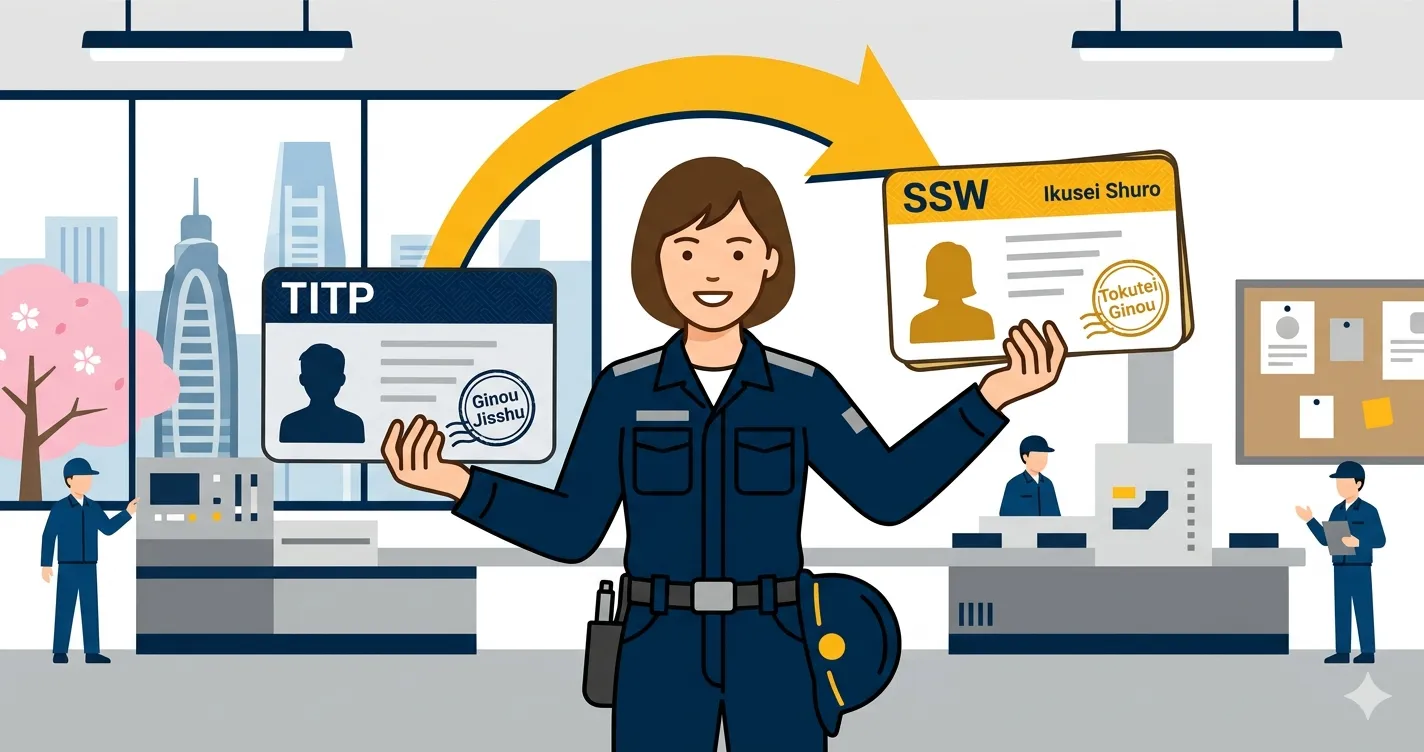
ESD Visa Japan 2027: Complete Guide to Employment for Skill Development
🇯🇵 日本語要約
2027年4月1日、技能実習制度が廃止され「育成就労制度」がスタート。3年間の育成期間で特定技能1号レベルを目指す。入国時はJLPT N5相当が必要、雇用主は100時間以上の日本語教育を提供義務。同一分野内での転籍が可能(1〜2年後、条件あり)。異なる分野への転籍は不可。介護・建設・農業・食品製造・宿泊業などが対象分野の見込み。既に技能実習中の人は旧制度のまま完了、途中でのESD移行は不可。
Quick Facts
| Question | Answer |
|---|---|
| What does ESD stand for? | Employment for Skill Development (Japanese: 育成就労, Ikusei Shūrō) |
| What does it replace? | The Technical Intern Training Program (TITP / 技能実習) |
| Start date | April 1, 2027 |
| Program length | 3 years |
| Goal | Reach Specified Skilled Worker (SSW) Type 1 level by year 3 |
| Minimum Japanese to enter | JLPT N5 or JFT-Basic (CEFR A1) |
| Minimum Japanese for SSW Type 1 | JLPT N4 equivalent |
| Can you change jobs? | Yes, within same field, generally after 1-2 years |
What Is the ESD Visa?
The Employment for Skill Development (ESD) program is Japan's new entry route for foreign workers in blue-collar and mid-skill jobs. It officially replaces the Technical Intern Training Program (TITP), which Japan is retiring after years of criticism over worker exploitation and workers being unable to leave abusive employers.
Where TITP was framed as "international skills transfer," ESD is honest about its real purpose: filling Japan's labor shortage while keeping workers in Japan long-term. Under ESD, you are treated as an employee from day one, not a "trainee."
ESD vs TITP vs SSW
| Feature | TITP (ending) | ESD (from Apr 2027) | SSW (after ESD) |
|---|---|---|---|
| Max stay | 3-5 years | 3 years | Type 1: up to 5 yrs / Type 2: unlimited |
| Job/employer change | Almost never | Allowed, same field only | Allowed, easier same field |
| Japanese requirement | None | JLPT N5 to enter | JLPT N4+ |
| Family accompaniment | No | No | Type 1: No / Type 2: Yes |
| Path to PR | Indirect only | Leads into SSW | Type 2 can lead to PR |
Which Industries Are Covered?
ESD industrial fields are expected to closely match the 16 SSW fields, since the design goal is a smooth handoff from ESD to SSW. Confirmed labor-shortage sectors include caregiving (介護), construction, agriculture, food manufacturing and food service, fisheries, hospitality, and manufacturing of industrial products.
Not included: fields requiring a license from day one, such as aviation ground handling and bus/truck transportation — these stay SSW-only.
Japanese Language Requirements
This is the biggest change from TITP, which required zero Japanese ability to enter. ESD requires JLPT N5 or JFT-Basic (CEFR A1) just to start. Your employer must provide at least 100 hours of Japanese lessons during the 3-year program, paid for by the employer. To move up to SSW Type 1 you generally need JLPT N4 level.
Can You Change Jobs Under ESD?
Yes — this is the headline improvement over TITP, but it is not unlimited.
- Same field, different employer: allowed, generally after working 1-2 years and meeting skill/attendance conditions
- Different field entirely: not allowed — you must pass a new field's skills test
- Unfair dismissal or abuse: transfer is allowed immediately, and the offending employer is banned from hiring ESD workers for one year
Job-hunting support goes through your supervising organization, the new Organization for Foreign ESD, or Hello Work — private recruiters cannot broker these transfers.
Rural vs Urban: Read the Fine Print
The government wants ESD workers filling shortages outside Tokyo and Osaka. Expect extra restrictions on transferring to jobs in major metro areas, while some rural employers may accept up to 3x the normal cap of foreign trainees. If your goal is eventually working in central Tokyo, your first 1-2 years under ESD may need to be in a regional area first.
Frequently Asked Questions
Is ESD the same as the Specified Skilled Worker (SSW) visa?
No. ESD is the 3-year training stage before SSW. Passing your field's skills exam at the end of ESD is what lets you move into SSW Type 1.
I'm already in Japan on TITP. Do I need to switch to ESD?
No. If you started TITP before April 1, 2027, you finish under the old TITP rules. You cannot mid-stream convert your status to ESD.
Can my spouse or children come with me on an ESD visa?
No. Family reunification only becomes possible if you later qualify for SSW Type 2.
What happens if I fail the exam to move from ESD to SSW?
You may get a short extension (up to about one year) specifically to retake the test. If you fail again, you will need to leave Japan when your ESD period ends.
Do I need to pay for Japanese lessons myself?
No. Your employer or supervising organization must fund at least 100 hours of lessons under ESD.
What EasyNihon Recommends Right Now
If a recruiter offers you a "TITP" job starting after April 2027, ask directly whether it is actually an ESD placement. Start basic Japanese study now, aiming for N5, even if not yet required. Keep copies of every contract and fee receipt from your sending organization. If you are currently on TITP and unsure about your own transition path, talk to a licensed 行政書士 rather than relying on informal advice.
This guide reflects the ESD program structure as finalized in ministerial ordinances issued through early 2026. Field-specific rules are still being confirmed ahead of the April 1, 2027 launch — EasyNihon will update this page as official details are released.
🏷️ Related Topics:
Related Guides
Japan Business Manager Visa ¥30 Million Rule 2026: Complete Guide
On October 16, 2025, Japan's Immigration Services Agency (出入国在留管理庁 / Shutsunyukoku Zairyu Kanri-cho)
BusinessBusiness Manager Visa 2026: The New ¥30M + JLPT N2 Rules Explained
The Immigration Services Agency (ISA) implemented its most significant Business Manager Visa reform
BusinessStarting a Business as a Foreigner: Japan vs UAE, Singapore & Malaysia — Where Should You Actually Set Up in 2026?
On October 16, 2025, Japan quietly rewrote the rules for every foreign entrepreneur thinking about s
BusinessForming a Company as a Foreigner: Japan vs USA, UK & Singapore — Company Formation and Visas Compared for 2026
Here's the fact that trips up more people than anything else in this comparison: in every single cou
BusinessStarting a Crypto Business in Japan: What the 2027–2028 Reform Actually Opens Up, vs Singapore, UAE & Hong Kong
Japan just passed the most significant overhaul of its crypto regulatory framework since it first re
🛠️ Related Tools for This Article
Need More Help?
Check out our free tools for foreigners in Japan