The University & Language School Route: How Sri Lankan Students Build a Career in Japan
🇯🇵 日本語要約
スリランカ人学生が日本語学校や大学を通じて日本でのキャリアを築く方法について、費用、時間管理、文化的な注意点を解説します。
The University & Language School Route: How Sri Lankan Students Build a Career in Japan
Separate from the TITP and SSW labor pipeline, Japan has become a genuinely popular study destination for Sri Lankans — and it's a different kind of investment. You're not signing a fixed labor contract; you're building language ability, a Japanese academic or professional credential, and the flexibility to choose your own employer later. This guide walks through what that path actually looks like.
*Comparing this to TITP/SSW first? See our Sri Lanka-Japan Work & Study Agreements guide for the full comparison of all routes.*
The Real Shape of This Path
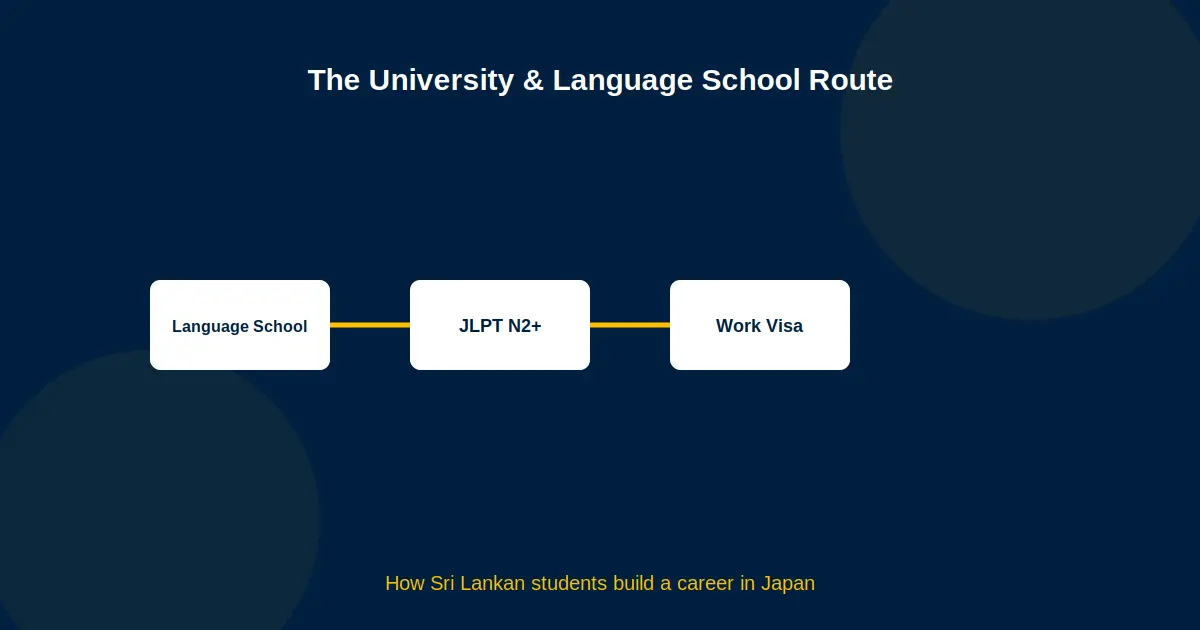
This typically takes 2-4 years from arrival to a stable work visa, similar to the timeline for other nationalities taking this route — but there are specific cultural and practical details worth knowing before you commit.
Step 1: Choosing Your Entry Point — Language School vs Direct University
- Language school first is the more common route if your Japanese isn't yet strong enough for direct university admission — most programs run 1-2 years, building toward JLPT N2 before you either enter university or move to work
- Direct university application is possible if you already have strong Japanese or are applying to an English-medium program (some Japanese universities offer these, particularly at the graduate level)
- Check school accreditation directly — the institution must be listed with Japan's Immigration Services Agency as eligible to sponsor Student visas; ask for their visa approval track record before paying any deposit
Step 2: The Visa Application
- You'll need a Certificate of Eligibility (COE), applied for by your school, before applying for the visa itself through VFS Global in Colombo — remember, Sri Lanka has no visa-exemption arrangement with Japan, so this formal process applies to every entry, including short visits
- Required documents typically include academic transcripts, a statement of purpose, and proof of funds — a financial guarantor demonstrating stable income is commonly required
- Be completely accurate on financial documentation — inconsistencies here are a common cause of delays or rejections
Step 3: Managing the 28-Hour Work Limit
Exactly the same hard rule that applies to every international student in Japan, regardless of nationality:
- Up to 28 hours per week during term time, extendable to 8 hours/day during official long school breaks
- This limit applies across all your jobs combined, not per job
- Violating it is treated as a status-of-residence violation, with consequences for visa renewal and future applications — not a minor administrative issue
Step 4: Adjusting to Japanese Workplace Culture — What Actually Trips People Up
This is the part that generic visa guides skip, and it's specifically flagged as an adjustment point for Sri Lankan arrivals:
- Punctuality is treated as a hard baseline, not a soft preference — arriving even a few minutes late to work or class is taken seriously in a way that surprises many new arrivals
- Hierarchy and seniority (先輩・後輩 relationships) shape day-to-day interactions — how you speak to someone senior to you, even by a small margin, differs meaningfully from casual Sri Lankan workplace norms
- Group harmony (和, *wa*) is a real operating principle in Japanese teams and classrooms — direct disagreement or standing out individually is generally handled far more indirectly than in more individualist work cultures
- These aren't abstract cultural notes — they show up concretely in how part-time job performance is judged, how group project dynamics work at school, and how smoothly your eventual job search and workplace integration go
Step 5: Building Toward JLPT N2 (or Beyond)
- Most stable work-visa transitions expect JLPT N2 at minimum; competitive roles increasingly want N1
- Consistent daily practice — not just class attendance — is what actually gets people there; part-time work is one of the most effective real-world practice environments available to you
- Budget realistically: reaching N2 from a low starting point typically takes 18-24 months of serious, consistent study
Step 6: Transitioning to a Work Visa
- Most graduates without a further university degree move toward SSW if their sector and JLPT N4/JFT-Basic level qualify, or continue toward a university degree to access the Engineer/Specialist in Humanities/International Services visa
- University graduates in relevant fields — including the growing pool of Sri Lankans pursuing IT, engineering, and business degrees in Japan — are well-positioned for direct Engineer/Specialist visa sponsorship
- Start your job search well before your Student visa nears expiry — Japanese companies often run structured recruitment cycles, particularly for new graduates, and early preparation gives you meaningfully more options
FAQ
Q: Is the language-school route more expensive than TITP or SSW?
Yes — you're covering tuition and living costs for 1-2+ years before earning a full salary. The tradeoff is stronger long-term Japanese ability and much greater flexibility in choosing your eventual employer and career path.
Q: Do I need a visa just to visit Japan to check out a school before enrolling?
Yes — Sri Lanka has no visa-exemption arrangement with Japan, so even a short exploratory visit requires a visa application through VFS Global in Colombo.
Q: How important is the cultural adjustment piece really, compared to just learning the language?
Genuinely significant. Language ability alone doesn't guarantee smooth workplace integration — the punctuality, hierarchy, and group-harmony norms described above are consistently cited as real adjustment challenges for new arrivals, independent of Japanese fluency level.
Q: Can I switch from language school directly into SSW instead of university?
Yes, if your JLPT level (N4/JFT-Basic minimum) and target sector align, and you pass the relevant skills test — this is a common route for language-school graduates who don't pursue further university study.
Q: What happens if I violate the 28-hour work limit accidentally?
It's still treated as a status-of-residence violation regardless of intent, and it can affect visa renewal and future applications. Track hours carefully rather than relying on memory, especially with multiple part-time jobs.
*This guide reflects Japan's student visa system as of mid-2026. Requirements, work-hour rules, and school accreditation status can change — always confirm current details with the Embassy of Japan in Colombo and your specific school's visa support office.*
🏷️ Related Topics:
Related Guides
Need More Help?
Check out our free tools for foreigners in Japan