Japan Needs 790,000 IT Workers by 2030 — The Opportunity Most Bangladeshi Tech Talent Is Missing
🇯🇵 日本語要約
バングラデシュのIT人材が見逃しがちな、日本のエンジニアビザとハイスキル人材制度による就労機会について解説します。
Japan Needs 790,000 IT Workers by 2030 — The Opportunity Most Bangladeshi Tech Talent Is Missing
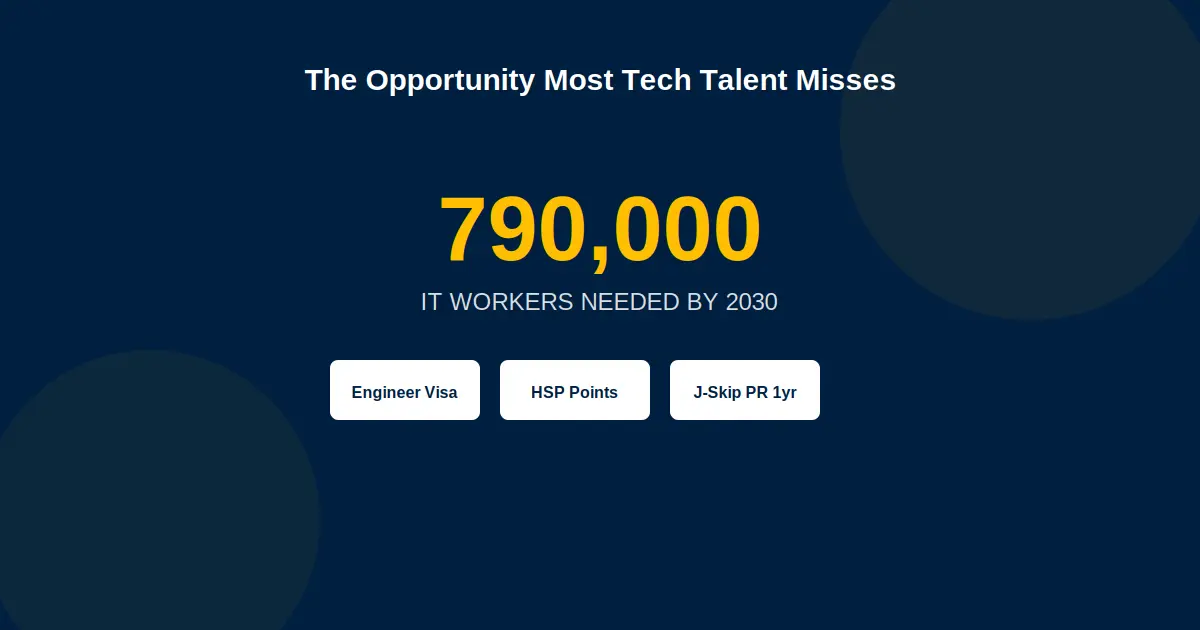
When most Bangladeshis think about working in Japan, the image is factory floors, caregiving wards, or construction sites — TITP, SSW, the pipelines everyone talks about. There's a completely separate, higher-paying track that gets far less attention: Japan's technology sector, which is short by an estimated 220,000 to 790,000 IT professionals by 2030. If you're a software developer, data engineer, or IT graduate in Bangladesh, this door is wide open and comparatively under-crowded.
Why This Track Looks Completely Different
Unlike TITP or SSW, the IT/Engineer route in Japan:
- Doesn't require Japanese language at entry for many roles — international companies operating in Tokyo, including Rakuten, Mercari, LINE, and SmartNews, actively hire English-speaking foreign engineers
- Pays significantly more — realistic starting salaries of ¥3.5M–¥5.5M/year, with experienced engineers at ¥6M–¥10M+
- Uses the Engineer/Specialist in Humanities/International Services visa — a completely different, standard visa category, not tied to any Bangladesh-specific bilateral agreement
- Has a genuinely fast track to Permanent Residency for higher earners
The Visa That Actually Applies to You
Engineer/Specialist in Humanities/International Services
This is Japan's standard white-collar work visa, and it's what almost all foreign software engineers in Japan actually hold.
- Requires a bachelor's degree in a related field, OR 10 years of relevant work experience (3 years for International Services roles like international marketing/business)
- Covers software developers, IT infrastructure specialists, data scientists, and system analysts directly
- Visa duration: 1, 3, or 5 years, renewable indefinitely, with a path to Permanent Residency after sufficient continuous residence
⚠️ A 2026 change worth knowing: as of April 15, 2026, Category 3/4 employers (generally smaller or newer companies) now require JLPT N2 for customer-facing roles under this visa. Category 1/2 employers (large or publicly listed firms) are exempt from this requirement. If you're targeting a smaller company, factor N2-level Japanese into your preparation; if you're targeting a major listed tech firm, this specific rule doesn't apply to you.
Highly Skilled Professional (HSP) — The Fast Track
If your qualifications and salary are strong, this points-based visa is worth understanding early, not after you've already been in Japan for years.
- A points system scoring academic background, professional experience, salary, age, and bonus factors like Japanese language ability
- 70+ points: eligible for Permanent Residency after just 3 years
- 80+ points: eligible after just 1 year — the fastest employer-sponsored path to PR available anywhere
J-Skip — Even Faster, For Top Earners
A newer fast-track specifically for high earners: professionals earning ¥20M+ annually with a Master's degree or 10+ years of experience can skip the HSP points calculation entirely and apply for PR after just 1 year. This is a genuinely fast route if your experience and salary level qualify.
Where the Demand Actually Is
- Digital transformation (DX) across traditional Japanese industries — banks, manufacturers, and retailers all modernizing legacy systems
- AI and machine learning — LLM-related systems, MLOps, and data platform roles are expanding, not shrinking, despite broader AI industry debates
- Cloud and SaaS infrastructure — ongoing expansion even as some debate the long-term SaaS business model
- Fintech — Japan's digital payments and financial technology sector is a specific growth area for English-speaking engineering talent
How Bangladesh's Existing IT Strength Fits
Bangladesh has a genuinely established domestic IT and software outsourcing industry — university computer science programs, a growing freelance/remote development community, and companies already delivering software services internationally. This is directly relevant experience for the Japanese market: Japan doesn't need to be convinced Bangladeshi developers can do the work; the gap is mostly about awareness that this specific route exists, separate from the TITP/SSW pipelines most recruitment conversations focus on.
A Realistic Path Forward
FAQ
Q: Do I need to speak Japanese to get an IT job in Japan?
Not necessarily at entry, especially at large international-facing tech companies where English is the working language. However, Japanese ability — even N3/N2 level — significantly expands your options and speeds up career progression, and is now specifically required for customer-facing roles at smaller employers as of April 2026.
Q: Is this route actually separate from Bangladesh's TITP/SSW agreements?
Yes, completely. The Engineer/Specialist, HSP, and J-Skip pathways are part of Japan's standard national visa system, open to any nationality — there's no Bangladesh-specific bilateral agreement involved, which also means there's less "official portal" hand-holding; you're applying more like a standard international job candidate. See our full agreements comparison guide for how this fits alongside TITP, SSW, and the student pathway.
Q: I'm currently in Japan on a language-school student visa — does this apply to me?
Yes, directly — this is one of the most common transitions for language-school graduates with a relevant degree. See our language school to work visa pathway guide for the full transition process, including timing your job search correctly.
Q: What's a realistic starting salary for a Bangladeshi software developer with 2-3 years of experience?
Based on current market data, realistically ¥3.5M–¥5.5M/year, with meaningful upward movement as you gain Japan-specific experience and, if relevant, Japanese language ability.
Q: Can I apply for these visas from Bangladesh, or do I need to already be in Japan?
Most companies prefer hiring from within Japan, but genuine international hiring does happen, particularly at larger tech companies actively building international teams. Remote-first international recruitment for Japan-based roles is more limited than fully remote global tech hiring, so confirm directly with any company whether they hire and sponsor from overseas.
Q: How is this different from Japan's Highly Skilled Professional visa in India, which has an EPA structure for some professions?
Bangladesh doesn't currently have an equivalent structured bilateral agreement for IT/professional roles the way some EPA arrangements exist for specific fields like nursing in other countries — Bangladeshi IT professionals use the standard national system rather than a dedicated bilateral IT pathway.
*This guide reflects Japan's visa system and IT labor market as of mid-2026. Visa category requirements, JLPT thresholds, and points-system criteria change — always confirm current requirements directly with Japan's Immigration Services Agency (isa.go.jp) or a licensed immigration specialist before making career decisions.*
🏷️ Related Topics:
Related Guides
Need More Help?
Check out our free tools for foreigners in Japan